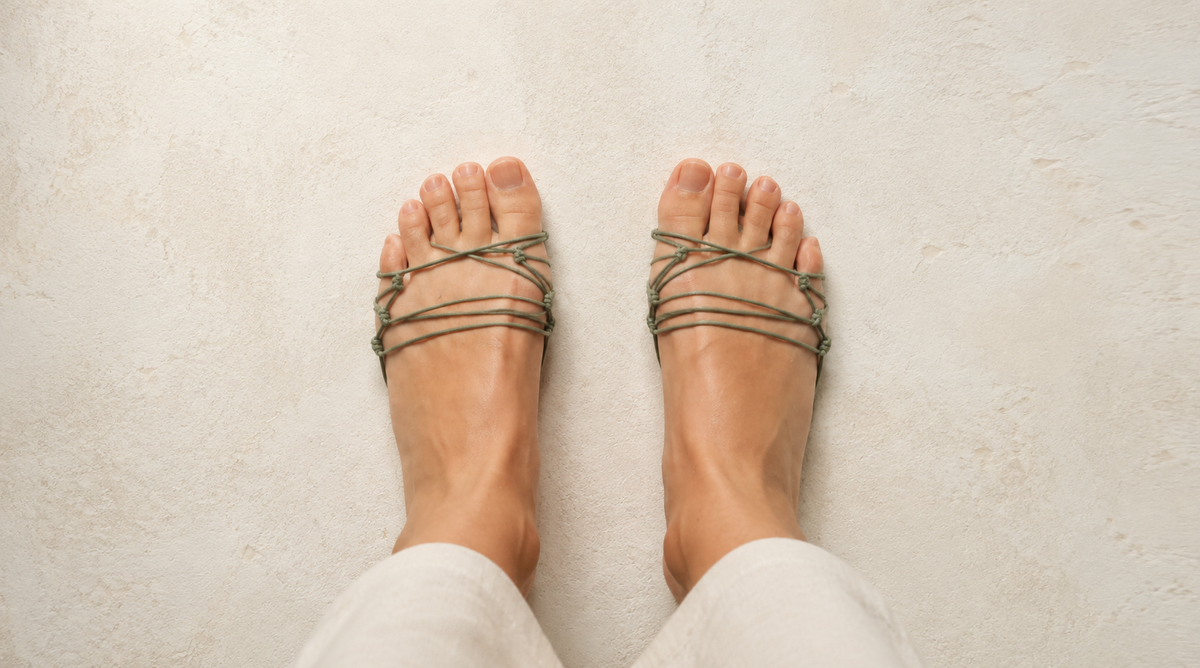
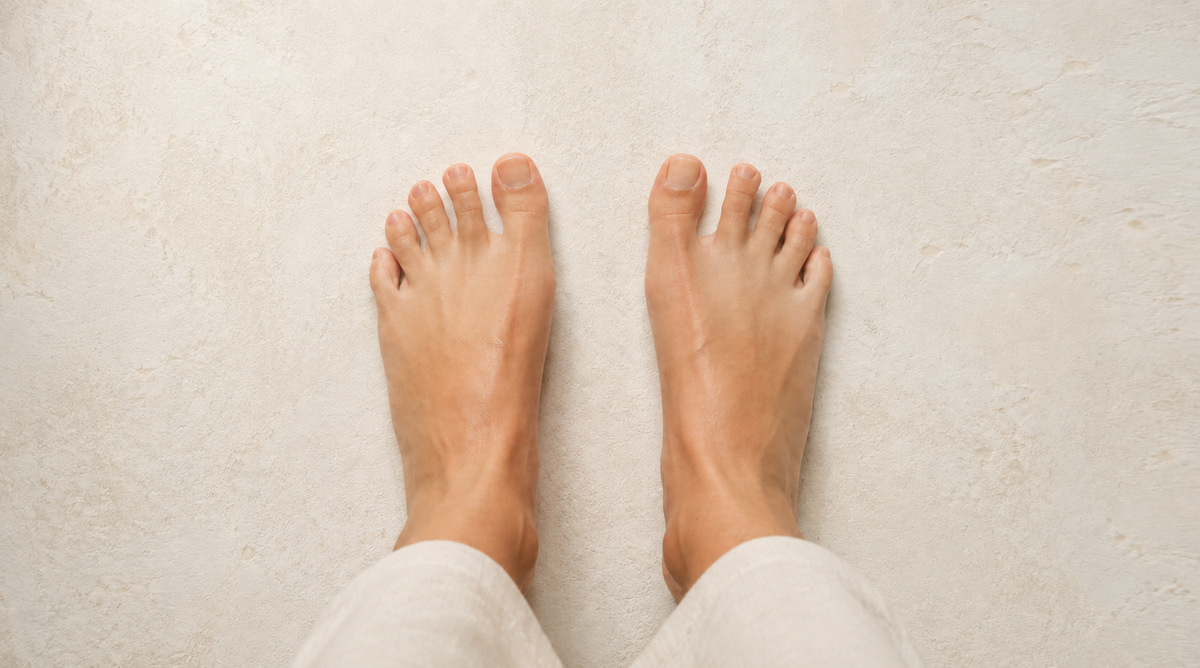
Barefoot: Walk the Way Your Body Was Designed
Rediscover the natural movement of your feet
Every step should feel free, just as your body was designed to move.
But modern footwear has changed that natural way of walking, almost without us realizing it.
What is barefoot?
Barefoot: walk as nature intended
The human foot has over 200,000 nerve endings and a structure designed to adapt to any surface, cushion impact, and maintain natural balance.
Conventional footwear, with its rigid sole, narrow toe box, and elevated heel, restricts this natural movement and weakens the foot muscles over time.
earthies is designed not to interfere with this process.
Why do conventional shoes interfere?
-
earthies
Flexible: adapts to every step.
Wide toe box: respects the natural shape of the foot.
Flat design (zero drop): maintains your natural posture. -
-
Conventional footwear
Stiff sole: restricts the natural movement of the foot.
Narrow toe box: compresses the toes.
Elevated heel (drop): alters your posture and gait.


Barefoot Characteristics
WIDE TOE
ZERO DROP
FLEXIBLE
THIN FLAT SOLE
Benefits of Barefoot
-
Improved Foot Strike
It re-educates your stride towards a more natural gait, with less impact and better absorption from the foot.
This helps correct support patterns forced by conventional footwear.
-
Strengthens feet, legs, and muscle chains
Walking barefoot activates more muscles, tendons, and ligaments, helping to prevent injuries.
Feet become stronger and more resilient to movement.
-
Improves posture and balance
Being closer to the ground and without heel elevation, the body aligns more naturally.
This improves balance, stability, and weight distribution when walking.
-
Reduction of joint tension
It promotes a softer, more conscious stride, relieving pressure on the knees, hips, and spine.
A more natural movement also reduces joint stiffness.
-
Greater bodily and sensory awareness
The thin sole allows you to feel the ground under your feet. That information reaches the brain and improves proprioception, the awareness of your body in space.
-
Natural foot movement
It allows the foot to move freely, without restrictions.
Forgotten muscles are activated, and the natural function of the toes, arch, and ankle is restored.
How to Transition to Barefoot
Do you already practice barefoot walking, or are you coming from conventional footwear?
If your feet are already accustomed to barefoot walking, earthies is simply another option for your daily life: just put them on and enjoy from the first step.
If you're coming from conventional footwear, your body might need a little time. Here's a simple guide to make the transition at your own pace.
It starts at home
Walk barefoot or with earthies for a few minutes a day, letting your foot reconnect with natural movement before going out.
Alternate
Start using your earthies in your daily life, alternating them with your usual footwear. Gradually increase the time, without forcing it.
Finding the change hard?
Not all feet adapt at the same pace. If you need more support at first, our transition insoles (4-8 mm drop) will soon be available to accompany you through the process, step by step, until you reach zero drop.
Enjoy the change
With consistency, you'll notice a more natural gait, better balance, and more body awareness with each step.
Welcome to walking as your body was designed.
Now that you know how it works, feel it
100% leather · Real grounding · Barefoot design
Research on barefoot running. What the science says
Foot Muscle Strength and Structure
- Systematic review (Journal of Foot and Ankle Research, 2022)
Analysed 9 studies and found that minimalist footwear increases foot muscle strength by 9% to 57% and muscle size by 7% to 10.6%. Read the study.
- Original study (Scientific Reports, Nature, 2021)
After six months of daily use of minimalist footwear, foot strength increased by 57.4% on average. Read the study.
- Comparative study between populations (PubMed, 2018)
Comparing habitually barefoot or minimalist-shod people with people wearing conventional footwear, the use of shoes with a narrow toe box and arch support is associated with weaker foot muscles and a less rigid arch during walking. Read the study.
Arch and foot development
- Multicentre study (Scientific Reports, Nature, 2017, Hollander et al.)
810 children and adolescents compared: growing up habitually barefoot is associated with a higher arch and a smaller hallux (big toe) angle in all age groups. Read the study.
- Controlled trial in infants (PLOS ONE, 2022)
In infants starting to walk, wearing barefoot-style footwear compared with conventional footwear produced differences in foot structure and gait pattern as early as seven months. Read the study.
Balance and proprioception
- Randomised controlled trial (PLOS ONE, 2024)
Four weeks of walking in minimalist footwear improved foot posture and balance in young adults. Read the study.
- Original study (PMC, 2024)
Ultra-minimalist footwear improves sensory activation of the sole of the foot and postural stability compared with conventional footwear, while filtering out the excess painful stimulus that does occur when completely barefoot on uneven surfaces. Read the study.
- Study in older women (Journal of Foot and Ankle Research, 2023)
In women aged 66-82, there were no statistically significant differences in balance between minimalist and supportive footwear, although a trend in favour of minimalist footwear was observed in static balance. Read the study.
Wide toe box and forefoot health
- Review of risk factors (Journal of Foot and Ankle Research, 2025)
Narrow toe box footwear is recognised as a modifiable risk factor for the development of hallux valgus (bunions). Read the study.
- Blood flow study (Journal of Foot and Ankle Research, 2019)
Compressing the big toe inwards, as happens with a narrow toe box, reduces blood flow in the lateral plantar artery. Read the study.
FAQs Barefoot
How do I choose my earthies size?
In most cases, your usual size will be the right one.
To be sure, we recommend checking your foot length in our size guide. You can do it in two ways:
- Measuring your foot with a sheet of paper and a ruler and typing the measurement into our calculator.
- Printing our size sheet, standing on it with your heel against the wall and reading the band where your longest toe ends: that is your size.
If you are between two sizes, choose the larger one.
ORIGIN has a barefoot last with a wide toe box, designed to respect the natural shape of the foot and leave real room for the toes. Unlike conventional footwear, where the foot is usually squeezed into a narrow last, here the toes have space and can move freely.
The idea is simple: not to adapt your foot to the shoe, but to choose a shoe that respects your foot.
How long does the barefoot transition take?
It all depends on your starting point: how long you've been wearing conventional footwear and how gradual your transition is.
As a reference, most people notice functional adaptation in 4-8 weeks, although full adaptation (intense exercise) can take up to 3-6 months.
Can I run in earthies from day one?
If you already practice barefoot running or regularly run barefoot, yes. Your feet are already prepared.
If you come from conventional footwear, we do not recommend it at first: your body needs to adapt by walking first. We suggest at least 4-6 weeks of comfortably walking long distances.
Will I notice any discomfort at first?
If you've never used barefoot footwear before, it's possible to feel some fatigue or mild tension in your feet and calves during the first few weeks, as you are activating muscles that conventional footwear kept "asleep." This is a normal sign of adaptation, not injury. If the pain persists or is intense, consult a professional.
Is barefoot walking effective if I already have bunions, flat feet, or plantar fasciitis?
The barefoot design (wide toe box, no compression) can help to avoid making the situation worse and to encourage better support, but it is not a medical treatment.
If you have a diagnosed condition, consult your podiatrist.
It depends on the condition and on whether it is active or not. Barefoot does not "cure" these conditions or reverse them surgically, but the wide, non-compressive toe box design can help slow their progression and improve foot function in the long term (especially with early-stage bunions).
Flat feet are not something that needs "fixing", they are a normal anatomical variation. Barefoot can restore strength and mobility, but if yours is rigid or you have plantar fasciitis with active pain right now, make a much more gradual transition and consult your podiatrist first.